
Preamble
I am writing this on the evening of September 10, 2025, and I am utterly heartbroken as I consider the completely unnecessary death of Charlie Kirk and multiple teenagers shot at school in Colorado earlier today, the deaths of nearly 3,000 people on September 11, 2001, which will be memorialized tomorrow, along with other events of horrible and unnecessary violence, such as the capitol attack on January 6th, the murder of Iryna Zarutska on a train in Charlotte, and the conflict in Gaza.
I am not writing this to be political, the exact opposite, actually. I am writing this to try to center myself on the kingdom of God, rather than American politics. I have stated my convictions about politics and the kingdom of God in previous articles and podcasts and do not wish to rehash them here. I simply want to say that I am fully convinced that the kingdom of God does not align itself with republican or democratic politics, nor is it a central political position. Rather, the kingdom of God stands completely outside of the American political system and reigns down judgment on it as it fails to live out the values of the kingdom.
Therefore, while I appreciate thoughts, feedback, and disagreement on this article, as I do on all posts, I will not allow comments that seek to progress a political agenda. This is not the place for partisan politics.
I am posting this article days after these events for a purpose. First, for us as Christians to have constructive conversations about how we live in the world but not of the world, we must allow time for our immediate high emotions to subside, myself included. Secondly, I have absolutely no desire to use the deaths of other people for a personal, spiritual, or political agenda. Third, I want to allow people an appropriate time to grieve. I recognize that there is likely no appropriate amount of time to wait to accomplish all of these goals and that I likely have failed in all of this. I just ask for your grace and mercy as I present some kingdom thoughts.
Finally, I think I’m probably writing this more for myself than for anyone else. Many of my thoughts are incomplete, and this will likely come out in what follows. I pray that this article will not only help me to process the egregious events that have been taking place in our country, but also to perhaps begin some important dialogue about how the church can be a witness in the midst of such tragedies.
Main Body
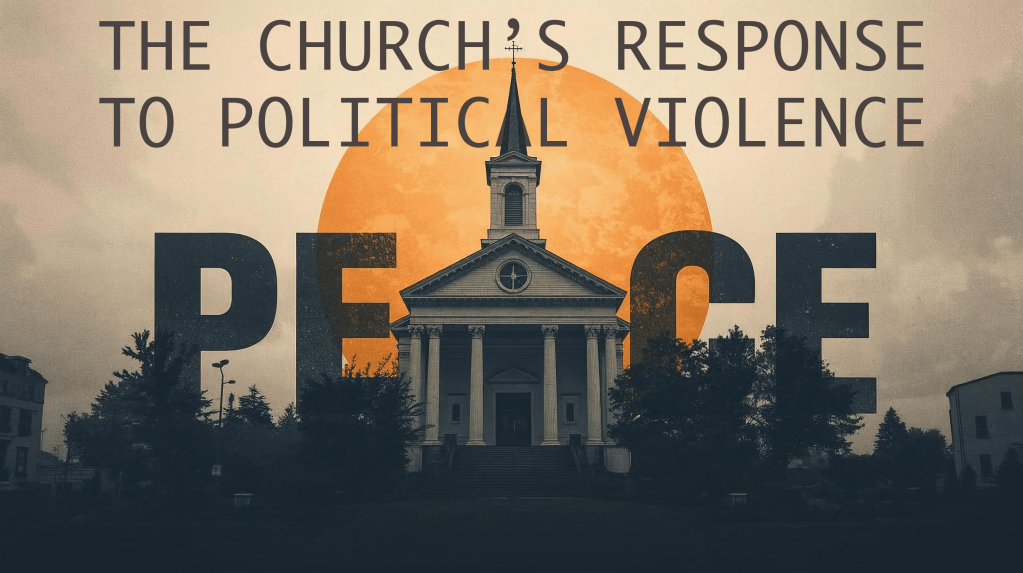
I have become increasingly convinced that the church’s response to the violence and death in our country and around the world is to pave a path of peace and nonviolence that reflects a different way of being human. The church’s response to world events must begin by looking to the man we follow, or at least claim to follow. All Christian thought, theology, and action begin at the cross. The cross is the decisive act in human history. It is the first event that climaxes Jesus’s ministry, leading to Jesus’s resurrection and his ascension to the throne of the kingdom of God.
For Christians, the cross is a symbol of hope, victory, forgiveness, and love. The cross reminds us that the evil of this world does not get the final say and that new life is to come. However, let’s not forget that the cross was first a symbol of violence and death. Long before the cross was taken up by Christians as a positive symbol, it was a symbol of Rome’s power to kill and destroy anything and anyone who dared stand against them. It was a politically violent symbol that Rome’s enemies would be hated and killed. It was not until a poor Jew from Nazareth stood up against the political power of Rome by declaring a new kingdom and new way of life, leading to his hanging on that very cross, that the symbol took on a new meaning.
The way of the cross (i.e., the way of Jesus) is a way of nonviolence. Jesus did not challenge Rome by picking up a sword. He didn’t try to garner support to become the next Caesar. When Satan offered him all the kingdoms (i.e., political power) of the world, Jesus turned him down. Rather, Jesus said that the greatest must become like the least and serve all. He said rather than hating your enemies, you are to love them, even to the point of giving up your life for them. Rather than taking life, Jesus chose to give up his life to redeem the creation, even forgiving the very people who put him on the cross.
As followers of Jesus, we walk in the way of the cross, or we are not followers of Jesus. I want to be direct here, because I believe it needs to be said. If we support violence, bloodshed, war, death, or hatred, or if we fail to stand up against the presence of such things in our society, then we are followers of Jesus by word only, for we are not actually following in Jesus’s footsteps. I am not making a claim about what a person believes about Jesus or a person’s salvation, simply that this is not the way of Jesus.
Therefore, the church’s response to the violence and death in our country and around the world is to pave a path of peace and nonviolence that reflects a different way of being human by shining the light of Jesus. Violence is never the answer. Death is an enemy we must consistently stand against. There have been many events recently that are reprehensible acts of evil, and we must call all of them by their name. We must live our lives and support things that stand for the lives of people, all people, from all places, who believe all things. In this, the church must be unwavering.
Our world is not only filled with violence, but we have also become so accustomed to it that we are no longer fazed. Violence covers our TVs, movies, and social media feeds. There is a shooting or a war happening constantly. The prevalence of violence has not only caused us to become casual observers of it, but, at times, to actually glorify certain forms of violence.
It is in this world and this context that the church must shine the light of Jesus as a different way of being human. Humans who move beyond casual observers of violence, and most definitely beyond glorifying it, to become active peacemakers. Humans who speak out against all acts of violence. Humans who model the self-sacrificial love of enemy modeled in Jesus.
P.S.
Love of neighbor and enemy means that we are intellectually honest in the way we approach topics and speak about issues. There is no one moment of violence that can be blamed in a generalizing way on an entire group of people or a political party. Christians cannot get upset when everyone who professes faith in Jesus is lumped together negatively and then do the same with others. Christians cannot say that we are pro-peace and anti-violence but then support it when it promotes our political ideology, country, or ally. This is not being intellectually honest and therefore does not reflect the values of Christ.
 Thinking Theologically